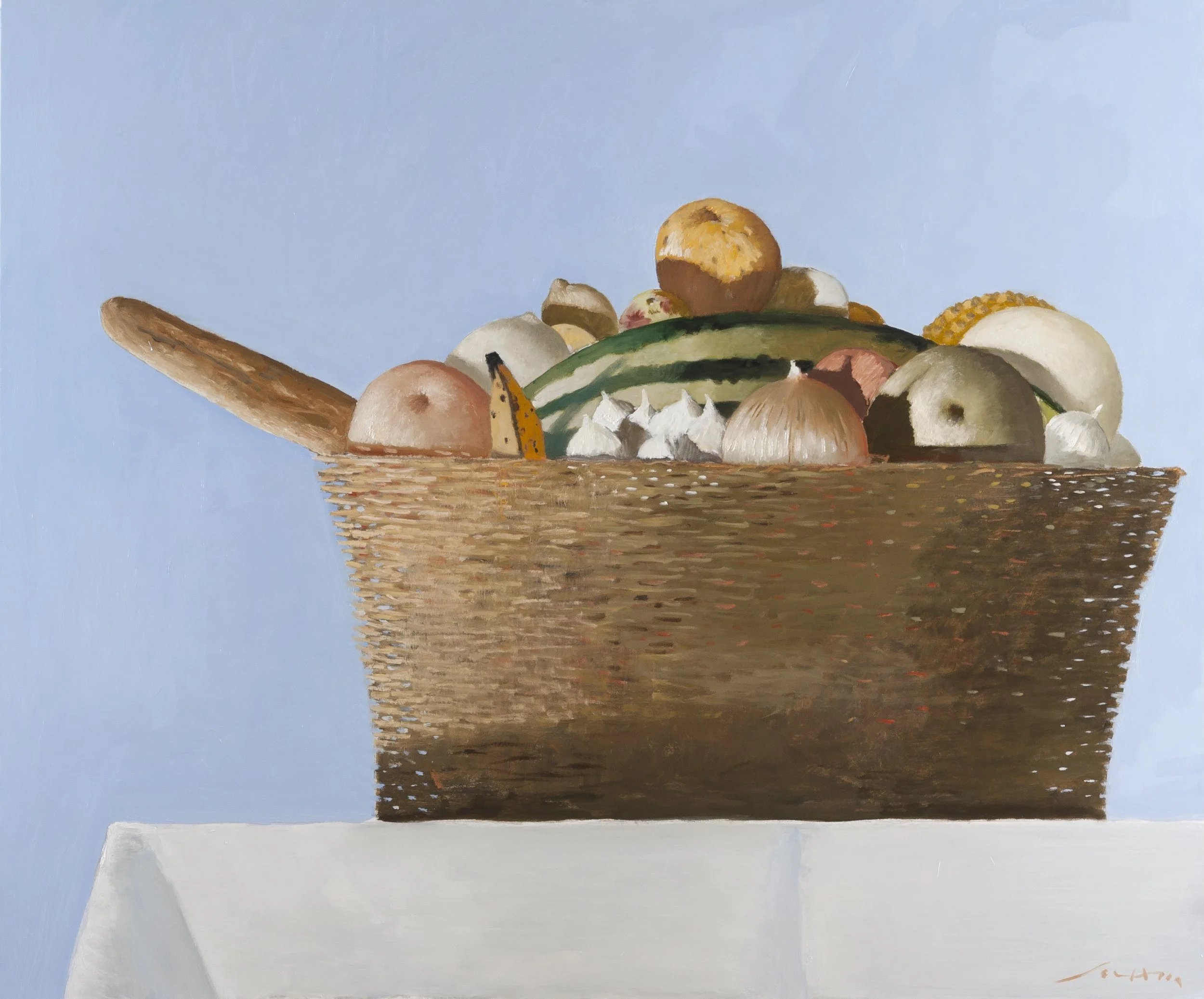
About Julio Larraz

Born in Havana, Cuba in 1944, Julio Larraz is a widely recognized contemporary Cuban-American artist celebrated for the psychological depth and visual sophistication of his paintings. His father, a political activist, was the owner and editor of La Discusión, a prominent Havana newspaper, and the political upheaval in Cuba in 1959 led the family to seek asylum in the United States when Larraz was just 16. He channeled that experience into pointed political caricatures published in The Washington Post, Vogue, and Time, before — under the guidance of mentor Burt Silverman — turning fully to painting and emerging as a recognized presence in contemporary art.

His professional acclaim began with a debut solo exhibition at the Pyramid Gallery in Washington, D.C., in 1971, and he subsequently showcased his work in galleries across the United States, Europe, and Latin America. His career has also encompassed sculpture and watercolor, with a particularly productive period spent in Italy during the late 1990s to early 2000s. Throughout, his work has entered significant private and public collections, and he has received grants and awards from the American Academy of Arts and Letters and the National Institute of Arts and Letters.

Larraz's paintings are defined by a distinctive visual language that draws on Surrealism, psychological realism, and a sustained preoccupation with metaphysical space. His canvases return repeatedly to the sea — at once a symbol of freedom, exile, and the unknown — alongside solitary figures, isolated interiors, and objects charged with quiet menace or latent narrative. The experience of displacement runs as an undercurrent through even his most tranquil compositions, inviting viewers into carefully constructed spaces where reality and imagination quietly converge. Larraz continues to evolve his practice, and his work endures as a testament to art's capacity to challenge perception and expand the boundaries of visual storytelling.